

Secure KVM Switches for Government: NIAP Certification, CAC Support, and SIPR/NIPR Switching Explained
TLDR
A secure KVM switch lets one operator work across two or more networks of different classification levels (for example NIPR and SIPR) from a single keyboard, monitor, and mouse, without ever creating a data path between those networks. For U.S. federal and defense use, the switch must carry a current NIAP certification against the Common Criteria Protection Profile for Peripheral Sharing Devices (PSD), the profile most buyers still call NIAP 4.0. The hardware enforces isolation physically through unidirectional data paths (optical data diodes), dedicated per-port processors, tamper-evident seals, and a restricted peripheral set. A Common Access Card (CAC) reader port lets the same smart card authenticate to each connected machine while keeping card data isolated per channel. This guide explains each requirement in plain terms, compares the certification tiers side by side, and lays out what to verify on a specification sheet before a fiscal year-end purchase. Browse our secure KVM switches or configure with expert help before you order: KVMSwitchTech offers live pre-sales guidance at (216) 798-7530.
Table of contents
- What a secure KVM switch actually does
- NIAP certification, explained
- NIAP 3.0 vs 4.0: what changed
- How CAC support works on a secure KVM
- SIPR/NIPR switching and network separation
- Certification and feature comparison
- How to read a secure KVM specification sheet
- Buying ahead of fiscal year-end
- FAQ
What a secure KVM switch actually does
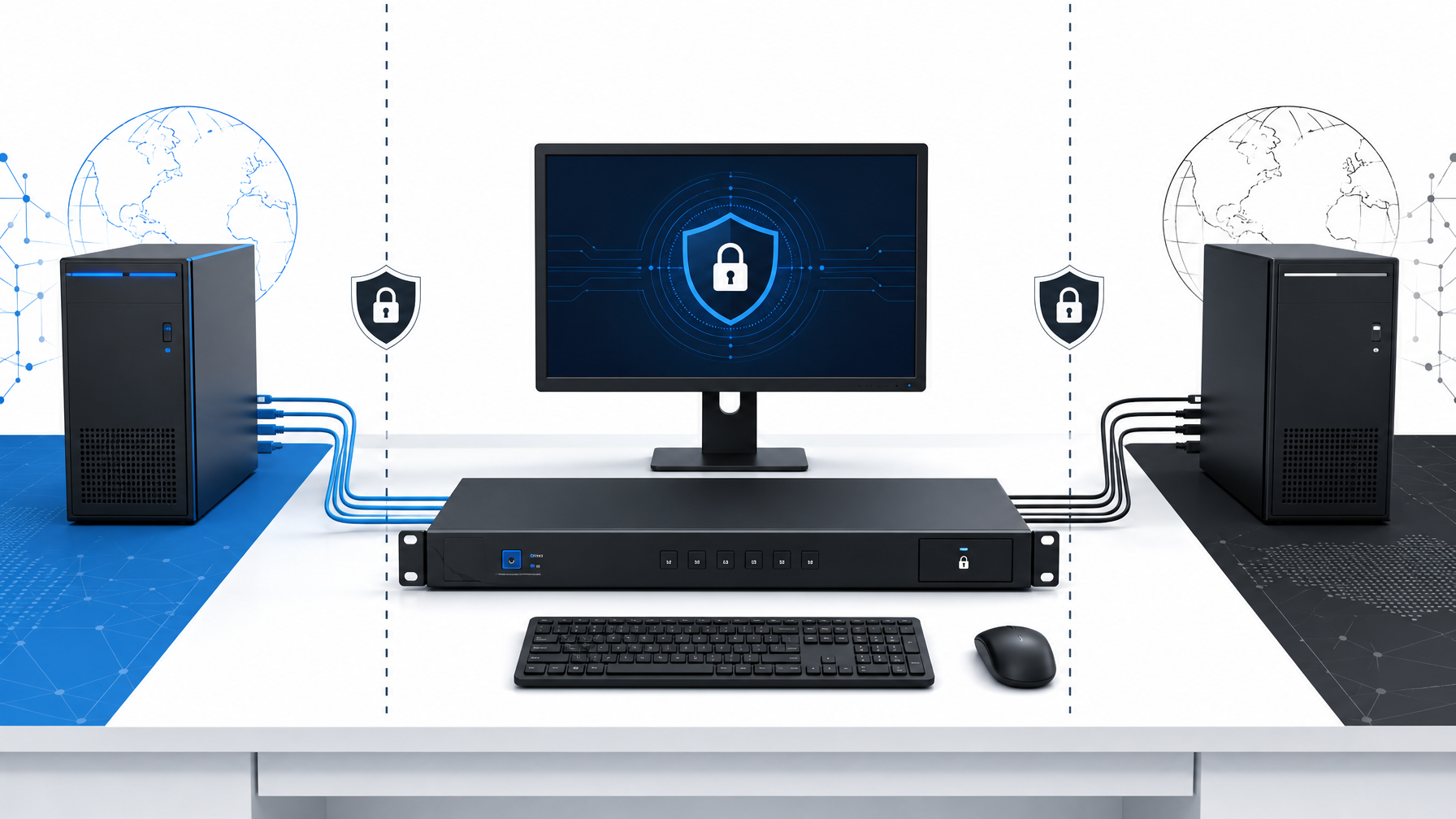
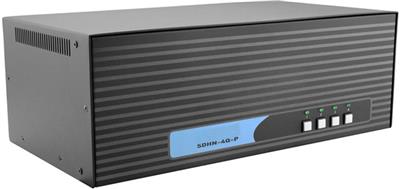
A standard KVM switch shares one set of peripherals across several computers as a convenience. A secure KVM switch does the same physical job but under a very different design goal: it must guarantee that data cannot leak from one connected computer to another through the shared keyboard, monitor, mouse, or card reader.
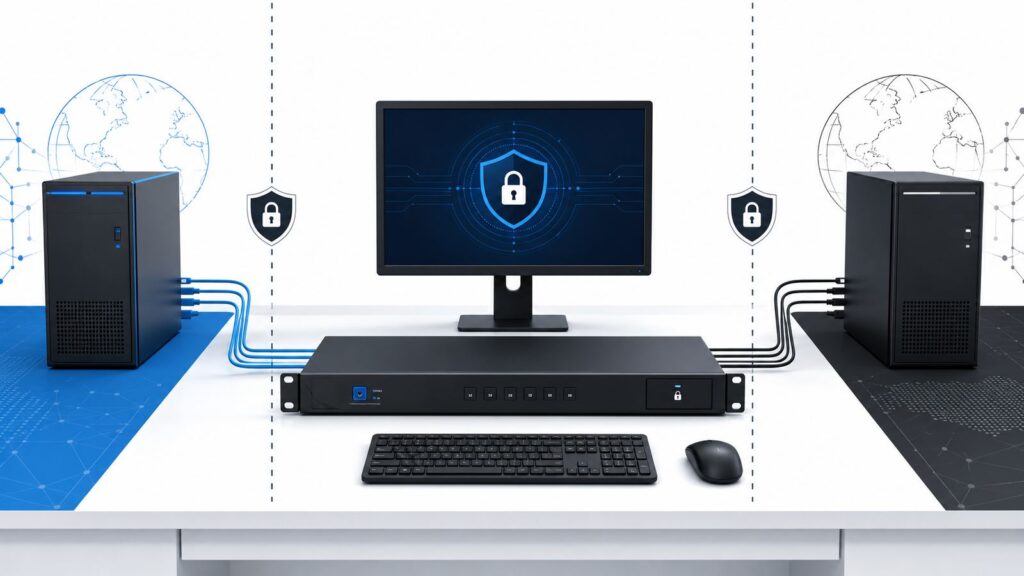
That distinction matters most in environments that run more than one network at more than one classification level. A watch floor analyst, an intelligence operator, or a base help desk technician often needs a classified network and an unclassified network at the same desk. Running two full workstations wastes space, power, and money. A secure KVM collapses that to one operator position while keeping the networks electrically and logically apart.
The security comes from hardware, not software policy. In a certified design, each port has its own isolated circuitry, keyboard and mouse data flows in one direction only, and there is no shared memory that could hold data from one channel and release it to another after you switch. Manufacturer documentation from Belkin and others describes these as "unidirectional data paths" built with "optical data diodes" that physically prevent a peripheral from being used to breach a connected system (Belkin, via KVM Switches Online).
NIAP certification, explained
NIAP is the National Information Assurance Partnership, a U.S. government body run under the NSA that oversees Common Criteria evaluations for national security systems. NIAP publishes Protection Profiles, which are standardized security requirement documents that a product category must be tested against.
For KVM and peripheral sharing hardware, the relevant document is the Protection Profile for Peripheral Sharing Device (PSD). NIAP approved PSD version 4.0 in January 2020, and it remains the profile buyers reference today (NIAP, Protection Profile for Peripheral Sharing Device v4.0). The profile defines a peripheral sharing device and specifies the security functions a vendor must implement and prove, from data path isolation to tamper response (Common Criteria, PSD v4.0).
The word that matters on a purchase order is "certified," not "compliant." A certified product has completed evaluation by an accredited lab and appears on the NIAP Product Compliant List with a Validation ID, as the Tripp Lite Secure KVM CAC models do (NIAP product listing). A product marketed as "compliant" or "designed to meet" the profile may never have been independently validated. For federal accreditation packages, insist on a live NIAP listing and the associated Validation ID.
NIAP 3.0 vs 4.0: what changed
Buyers still encounter both version numbers in the field, because older certified inventory carried the earlier profile. The earlier standard was the Protection Profile for Peripheral Sharing Switch (PSS) version 3.0. Version 4.0 renamed the category from "switch" to "device," reflecting a broader scope, and it tightened and expanded the security functions vendors must demonstrate (Black Box, NIAP 3.0 vs 4.0). Belkin's migration technical note maps the individual security functions from PSS 3.0 to PSD 4.0 for teams comparing older and newer units (Belkin technical note).
The practical guidance is simple: for a new procurement, specify current PSD 4.0 certification. Do not accept a 3.0-era unit for a fresh deployment unless your accreditation authority has explicitly approved it, because a certification tied to a superseded profile invites questions during an audit.
How CAC support works on a secure KVM
Common Access Card support is the feature most government buyers ask about first, and it is also the most commonly misunderstood. A CAC-enabled secure KVM adds a dedicated authentication device port, sometimes labeled a CAC port, that lets a smart card reader be shared across the connected computers alongside the keyboard, monitor, and mouse.
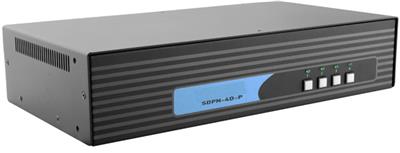
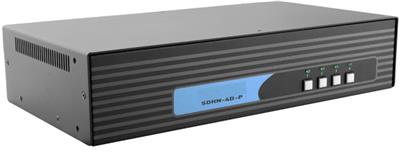
The security requirement is that the card reader channel is isolated exactly like the other peripherals. When you switch from the machine on port one to the machine on port two, the reader is electrically re-bound to the newly selected computer, and no residual card or credential data carries across. Certified CAC-capable units advertise this as a Protection Profile v4.0 feature with support for smart card and biometric readers (Tripp Lite via CDW). We stock CAC-enabled models such as the 4-port single-head Secure Pro DVI-I KVM with CAC port and the 8-port Secure Pro KM switch with CAC port.
Two configuration points to confirm before you order:
- CAC vs non-CAC part numbers. Vendors publish separate SKUs for CAC and non-CAC versions of the same switch. If your operators authenticate with smart cards, order the CAC variant explicitly; the non-CAC unit will not have the reader port.
- Reader compatibility and configurability. Some certified units let an administrator register which reader is allowed, so an operator cannot substitute an unapproved USB device. Confirm the switch supports the specific reader your agency has fielded.
SIPR/NIPR switching and network separation
The classic government use case is a single desk that reaches both NIPRNet and SIPRNet. NIPRNet is the Non-classified Internet Protocol Router Network used for unclassified traffic, and SIPRNet is the Secret Internet Protocol Router Network used for classified traffic up to the Secret level. Eaton's Tripp Lite documentation defines these networks in exactly those terms for its secure KVM line (Eaton Tripp Lite).
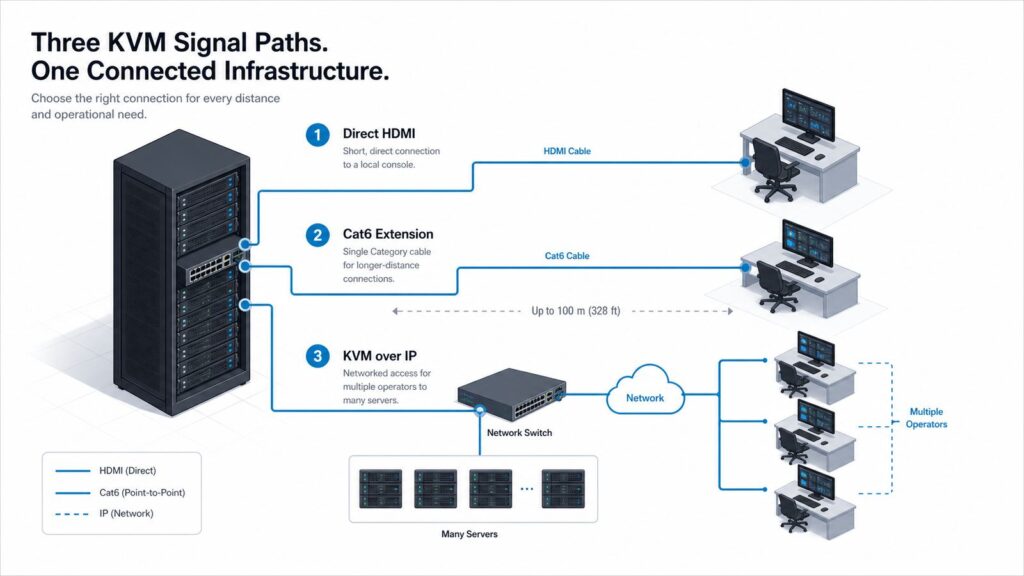
For teams weighing centralized remote access alongside desk-side switching, our data center KVM over IP decision framework covers the broader architecture trade-offs. A secure KVM makes single-desk access to both networks possible only because the isolation is absolute. Each computer connects to its own port, each port drives its own isolated data path, and the operator selects one network at a time. There is no bridge, no buffer, and no shared clipboard between channels. Third-party integrators describe the pattern as combining NIAP-certified switching with a stateless endpoint so that one workstation can reach SIPR and NIPR without ever connecting them (ClearCube).
Two governance points sit on top of the hardware:
- Accreditation still applies. The switch being certified does not by itself authorize a given SIPR/NIPR configuration. Your site security officer and the connection approval process govern how the networks may share a desk, and the certified switch is the enabling component within that approval.
- Approved product lists. Beyond NIAP, defense buyers frequently check the DISA DoDIN Approved Products List and, for classified solution stacks, the NSA Commercial Solutions for Classified (CSfC) components list (DISA APL, NSA CSfC). Confirm which lists your program requires before you finalize a part number.
Certification and feature comparison

The secure KVM market is served by a handful of established manufacturers, and KVMSwitchTech provides vendor-neutral guidance across them rather than steering every requirement toward one brand. The table below summarizes how the category commonly presents on certified units. Always confirm the exact figures against the current datasheet and NIAP listing for the specific SKU, because features vary by model within each brand.
| Attribute | What to look for on a certified secure KVM |
|---|---|
| Certification | Current NIAP PSD 4.0, live on the NIAP Product Compliant List with a Validation ID |
| Data path isolation | Unidirectional data paths with optical data diodes; dedicated per-port processors |
| Tamper protection | Tamper-evident holographic labels and an anti-tamper design that disables the unit if the enclosure is breached |
| CAC support | Dedicated authentication device port on CAC SKUs; configurable/registered reader |
| Video | Single or multi-head; DVI, HDMI, DisplayPort, or USB-C; 4K support where required |
| Country of origin | TAA compliance, and U.S. manufacture where the program requires it |
| Approved lists | Presence on DISA APL and/or NSA CSfC components list where your program mandates it |
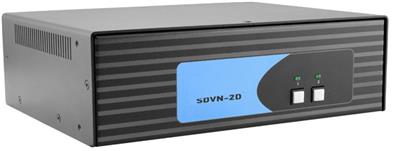
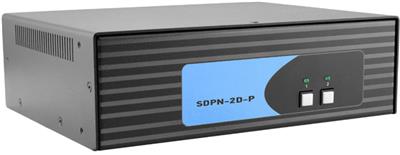
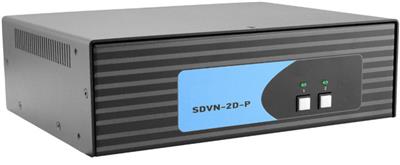
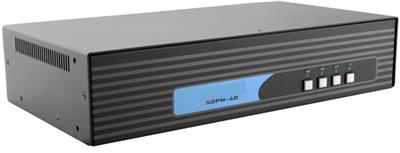
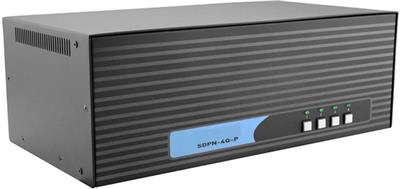
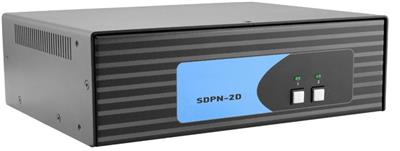
Manufacturers commonly seen in federal secure KVM procurements include Belkin, Black Box, Eaton Tripp Lite, ATEN, Vertiv Cybex, and IOGEAR, all of which publish NIAP PSD 4.0 certified models (Black Box NIAP 4.0 line, ATEN CS1184DP4C, Vertiv Cybex SC900 via CDW, IOGEAR GCS1322TAA4C). Because the manufacturer narratives naturally favor their own catalogs, an independent reseller is useful precisely when you need the model that fits your accreditation, port count, and video format rather than the model a single vendor happens to promote. Compare options across our full secure KVM switch range, including dual-head models like the 4-port dual-head Secure Pro DisplayPort KVM with CAC port.
How to read a secure KVM specification sheet
When a datasheet lands on your desk, work through these checks in order:
- Certification status and version. Look for "NIAP PSD 4.0 certified" plus a Validation ID you can look up on the NIAP site. "Compliant" without a listing is a flag to question.
- Port count and headroom. Match the number of networks at the desk today, and leave room if a third network is on the roadmap.
- Video format and resolution. Confirm the connector type (DVI, HDMI, DisplayPort, USB-C) matches your endpoints, and that resolution supports your displays, including 4K where used. For a deeper walkthrough of port count, 4K, and EDID considerations, see our HDMI KVM switch buyer's guide.
- Single vs multi-head. Operators running dual monitors per network need a dual-head unit, which changes the model line and the port math.
- CAC configuration. Verify the CAC SKU, reader compatibility, and whether the reader is administrator-registered.
- Tamper and country-of-origin. Confirm tamper-evident seals, TAA compliance, and U.S. manufacture if the program requires it.
- Approved product lists. Cross-check the DISA APL and CSfC components list against your program's mandate.
A mismatch on any single line can stall an accreditation package, so it is worth confirming each point with the reseller before the purchase order goes out.
Buying ahead of fiscal year-end
The U.S. federal fiscal year closes on September 30, and agencies routinely accelerate hardware spending in the final quarter to obligate remaining funds. Secure KVM units are a common late-year purchase because they are discrete, certified line items that support existing accreditations. Two realities make early engagement worthwhile:
- Certified stock moves quickly. CAC-variant and multi-head models are the ones that sell out first as year-end approaches. Confirming the exact SKU early protects your timeline.
- Configuration detail drives the order. Port count, video format, CAC vs non-CAC, and approved-list requirements all shape the correct part number. Getting these right the first time avoids a return cycle that year-end schedules cannot absorb.
KVMSwitchTech supplies secure and standard KVM switches, rackmount monitors, LCD console drawers, and related data center hardware, paired with live product guidance so a deployment does not fail on a detail like resolution, reader compatibility, or certification version. We are an expert advisor first, not a pushy retailer: configure with expert help before you order. To match a NIAP-certified secure KVM to your networks and accreditation package before fiscal year-end, call our team at (216) 798-7530.
FAQ
What does NIAP certification mean for a KVM switch?
It means an accredited laboratory tested the switch against the Common Criteria Protection Profile for Peripheral Sharing Device and NIAP validated the result, listing the product with a Validation ID. It is a formal, independently verified assurance that the hardware isolates connected networks as specified, not a self-declared claim.
Is NIAP 4.0 the current standard?
Yes. NIAP approved the Protection Profile for Peripheral Sharing Device version 4.0 in January 2020, and it is the profile new procurements should specify. The earlier 3.0 profile covered "peripheral sharing switch" and is considered superseded for fresh deployments.
What is the difference between a secure KVM and a regular KVM switch?
A regular KVM shares peripherals for convenience and offers no guarantee against data crossing between connected computers. A secure KVM enforces hardware isolation with unidirectional data paths, dedicated per-port processing, tamper-evident construction, and a restricted peripheral set, so it can safely sit between networks of different classification levels.
Can one secure KVM switch connect SIPR and NIPR at the same desk?
Yes, that is a primary use case. A certified secure KVM lets an operator select the classified network or the unclassified network from one keyboard, monitor, and mouse while keeping the two networks completely separate. Your site security officer and connection approval process still govern the configuration.
Do I need the CAC version of the switch?
If your operators authenticate with a Common Access Card or other smart card, yes. CAC and non-CAC versions are separate part numbers, and only the CAC SKU includes the isolated authentication device port. Confirm the reader you field is compatible with the model.
What else besides NIAP should I check for a defense purchase?
Depending on the program, verify TAA compliance and U.S. country of origin, and check whether the unit must appear on the DISA DoDIN Approved Products List or the NSA CSfC components list. Confirm these requirements with your program office before selecting a part number.