

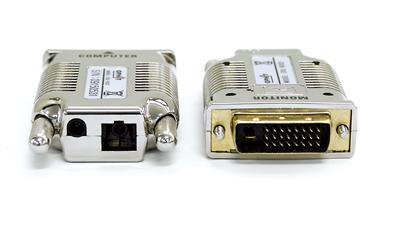
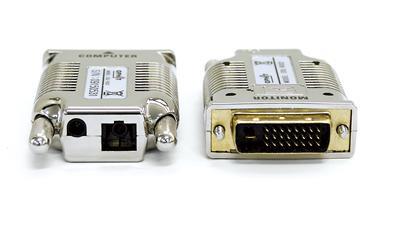

RFQs mix two SKUs that do different jobs. A fiber optic extender is a transmitter and receiver pair that converts HDMI, DVI, DisplayPort, or KVM to light and back. A fiber optic repeater sits in the middle of an already-optical path, regenerates the optical signal, and sends it onward. If the run fits one published extender budget, buy the pair. If it does not, size a hop, not a second extender SKU with the same part number.
This guide is for control-room and broadcast engineers who already know they need fiber, not Cat6. It covers distance bands, single-mode versus multimode, 4K30-class honesty, optical HDMI repeater placement, and the RFQ fields that stop purchasing from treating a fiber repeater as a duplicate extender.
Need a distance check on a live plant? Call (216) 798-7530 with fiber type, connector, measured length, and source resolution.
What a fiber optic extender actually is
An extender pair has an electrical port on each end (HDMI, DVI, DP, USB for KVM) and an optical port in the middle. Convert leftover VGA at the source. Do not buy a new VGA fiber kit. The TX encodes video, audio, and often USB or RS-232 onto a laser or VCSEL. The RX converts light back to copper. Published distances are SKU-specific. Typical commercial HDMI-over-fiber kits land in these classes:
| Class | Fiber | Typical published reach | What to treat as honest |
|---|---|---|---|
| Multimode HDMI pair | OM3/OM4 duplex or simplex LC | 300 m class | 4K30-class unless the sheet states 4K60 |
| Single-mode HDMI pair | OS2 LC, often SFP | 2 km to 10 km class | Confirm clock, HDCP, EDID, and power at both ends |
| KVM over fiber | SM or MM plus USB | 300 m to 20 km depending on SFP | USB 2.0 HID is not USB 3 storage |
Those numbers come from vendor sheets in the AV market (OREI 10 km single-mode / 300 m multimode kits, AV Access 300 m multimode HDMI, Lightware HDMI 2.0 optical heads in the 600 m 4K / 1200 m Full HD band). Treat them as catalog maxima, not as a guarantee on your plant. Connector loss, patch-panel count, dirty LC faces, and the wrong SFP wavelength eat budget fast.
An extender does not sit in the middle of two fiber trunks. If someone asks for an "optical HDMI repeater" and they mean TX/RX at the wall, they want an extender.
What a fiber optic repeater actually is
A fiber repeater takes light in and puts light out. It does not present HDMI to the operator. In telecom, that family includes 3R regenerators (reshape, retime, retransmit) and optical amplifiers such as EDFA in the 1550 nm C-band. In AV and industrial Ethernet, the practical box is a media-converter or SFP repeater that reclocks a 1G or 10G optical stream, often sold as a kit that stretches a fiber run on the order of 40 km when the original SFP was only rated for a few kilometers.
IEEE 802.4-era industrial fiber repeaters still exist for carrier-band plants and quote fiber segments up to 50 km. Those are not HDMI boxes. Do not drop an industrial Ethernet repeater into an HDMI-over-fiber path and expect EDID or HDCP to survive.
For HDMI and KVM, a true optical HDMI repeater is rare as a named SKU. Most "repeat" jobs are one of three designs:
- Two extender pairs daisy-chained through an HDMI loop-out at a mid-span rack (electrical hop, not optical).
- An SFP-based long haul fiber extender with a higher-budget optic (still one TX/RX pair).
- A 3R optical regenerator or dual-SFP media converter in the middle of a single-mode trunk when the video payload already rides Ethernet or SDI, not native HDMI.
If the payload is native HDMI on dedicated fiber, option 2 is usually cheaper and cleaner than option 3. Option 1 adds an electrical conversion, extra HDCP handshake, and another power outlet. Use it only when you already have a mid-span rack with displays or a matrix.
Fiber optic extender vs repeater: decision table
| Question | Extender pair | Fiber repeater / hop |
|---|---|---|
| Ends of the run | Copper video or KVM | Optical in, optical out |
| Typical AV job | Source rack to display wall | Campus or campus-to-building after the first conversion |
| Extra conversion | One E/O and one O/E | One more O/E/O or 3R |
| Latency | One codec or pass-through hop | Adds a hop; 3R is low, compressed HDMI stacks |
| When to buy | Distance and fiber type fit one SKU sheet | Measured loss or length exceeds that sheet |
| Wrong buy | Two identical extender kits "in series" on fiber with no HDMI in the middle | A Wi-Fi repeater or Cat6 HDMI extender labeled "fiber" in a marketplace title |
Wi-Fi range extenders dominate search results for "repeater." Ignore them. A fiber repeater is not a dual-band AP.
Distance bands that belong on the RFQ
Size the plant in bands, then pick the SKU. Do not start from a catalog number and stretch it.
Band A: in-rack to adjacent room (under 100 m)
Copper HDMI is already a gamble past about 15 ft at 4K. Cat6 HDBaseT or HDMI-over-Cat still competes here. Fiber is optional unless EMI, isolation, or future 4K headroom is the driver. A fiber optic repeater is not in scope.
Band B: building backbone (100 m to 300 m)
This is the multimode HDMI extender band. OM3/OM4 duplex LC kits at 300 m are the default. If the measured run is 280 m with four LC pairs, do not assume 300 m of headroom. Count 0.3 to 0.5 dB per connector pair and stay inside the receiver's optical budget. No repeater.
Band C: campus (300 m to 2 km)
Switch to single-mode unless the plant is already OM4 and the SKU sheet lists 2 km, which most HDMI MM kits do not. A long haul fiber extender (2 km class) is still one pair. Repeat only if the path is two dark-fiber segments that cannot be fusion-spliced into one.
Band D: long haul (2 km to 10 km)
Single-mode OS2, LC or SC, often SFP. 10 km HDMI-over-fiber kits exist in the commercial catalog. Confirm:
- Resolution and chroma (many "4K60" kits use compression or 4:2:0).
- Whether USB, IR, RS-232, and audio extract are in-band or a second fiber.
- Whether the SFP is locked to the chassis.
If the measured span is 12 km, do not "add a repeater" as a guess. Either step to a 20 km SFP class (common on KVM-over-fiber) or insert a 3R at a powered hut with the same wavelength and rate.
Band E: beyond 10 km
This is carrier or dark-fiber WAN, not a wall-plate HDMI kit. Use SDI/IP gateways, JPEG-XS or similar contribution codecs, or KVM-over-IP on a managed optical Ethernet path. A standalone optical HDMI repeater is the wrong product family.
Single-mode vs multimode (do not mix)
| Item | Multimode (OM3/OM4) | Single-mode (OS2) |
|---|---|---|
| HDMI kit reach | ~300 m typical | 2 to 10 km typical |
| Source | VCSEL ~850 nm | Laser 1310 or 1550 nm |
| Patching | LC duplex common | LC duplex or simplex with BIDI |
| Mix with the other type | No | No |
| Repeater optics | Must match MM SFP | Must match SM SFP and wavelength |
A multimode TX into single-mode plant will light a meter, then die. Label both ends. If the building has leftover OM1, do not reuse it for 4K HDMI fiber kits that assume OM3/OM4.
4K30-class honesty
Most KVMSwitchTech fiber video SKUs should be quoted as 4K30-class unless the sheet explicitly states 3840×2160 at 60 Hz. Compressed "4K60" over 10 km is a different product: it will pass a demo pattern and still fail a camera shade or a KVM mouse. For RFQs:
- State source timing (example: 3840×2160 30 Hz 4:4:4, or 1080p60).
- State whether the path must be uncompressed.
- Do not copy 4K60 from a competing datasheet onto a 4K30 chassis.
The K117e class exception (3840×2160 at 60 Hz via DisplayPort) is a DisplayPort KVM path, not a generic fiber HDMI repeater claim.
When a repeater hop is required
Use a hop when at least one of these is true:
- Length exceeds the extender sheet after connector loss. Example: 10 km SKU, 9.4 km fiber, six LC pairs, dirty plant. Budget fails. Either clean and recertify, or add a 3R at a mid-span rack.
- Two dark-fiber segments, no splice rights. Campus A to hut, hut to Campus B. The hut is the only place you can land optics. A dual-SFP regenerator or a pair of media converters back-to-back belongs there.
- Rate or wavelength change. 1310 nm 10 km SFP in, 1550 nm 40 km SFP out. That is a repeater or transponder, not a second HDMI extender.
- Electrical drop required anyway. Control room at 4 km wants a confidence monitor at 2 km. An HDMI loop-out extender at the 2 km rack is an electrical hop. Document HDCP and EDID at that point.
Do not add a hop because the salesperson ran out of 10 km kits and has 2 km kits in stock. Two 2 km HDMI extenders do not make 4 km unless there is a copper HDMI (or matrix) in the middle, with power, and a handshake that your sources tolerate.
Optical HDMI repeater vs daisy-chain extender
| Design | Signal at mid-span | HDCP/EDID | Power | Best use |
|---|---|---|---|---|
| One long haul fiber extender | None (dark fiber only) | One handshake | TX and RX only | Point to point |
| Daisy-chain two HDMI extenders | HDMI copper | Two handshakes | Three or four PSUs | Mid-span display or matrix |
| Dual-SFP 3R | Optical only | Payload already digital (IP/SDI) | One mid-span PSU | Hut with no HDMI sink |
| Marketplace "HDMI fiber repeater" | Unknown | Unknown | Unknown | Do not RFQ this name |
If the mid-span room has no display, prefer keeping the path optical. Every extra HDMI hop is another EDID table, another HDCP version fight, and another 5 V brick on a UPS.
KVM over fiber is not the same SKU
Keyboard and mouse add USB. HID usually rides the same fiber; storage and isochronous USB 3 often do not. A fiber optic repeater in the video path does not magically extend USB. If the operator is 8 km from the server:
- Confirm USB is in-band on that extender.
- Confirm whether CAC readers need USB 2 full speed, not HID-only.
- Do not assume a video-only 10 km HDMI kit is a KVM kit.
KVM-over-fiber with SFP options (including 20 km class on some industrial HDMI KVM extenders) is still an extender pair. Repeat only on the optical Ethernet or SFP segment, with matching SFPs.
RFQ checklist (copy into the bid)
- Source and sink connectors (HDMI, DP, DVI). Convert leftover VGA. Do not specify new VGA hardware.
- Timing: resolution, refresh, chroma, HDR yes/no.
- Uncompressed required: yes/no.
- Fiber in place: SM/MM, OS2/OM3/OM4, simplex/duplex, connector, measured length, OTDR or OLTS results if you have them.
- Patch-panel count and estimated connector loss.
- USB/KVM, IR, RS-232, audio extract: which fibers.
- Mid-span rack or hut: power, HVAC, whether a sink exists.
- One extender pair vs hop: state which, and why.
- SFP locked or field-replaceable; wavelength.
- HDCP version and EDID strategy (copy sink, emulate, matrix).
If item 4 is "unknown, about 2 miles," stop. Measure. "About 2 miles" is either Band C or Band D depending on route slack.
Common RFQ mistakes
Same SKU twice. Purchasing orders two identical HDMI fiber kits because the drawing shows two fiber segments. Without a copper HDMI in the middle, the second kit has nowhere to land.
Cat6 language on a fiber drawing. HDBaseT 100 m and PoH do not apply. Distance bands above replace them.
4K60 copy-paste. If the operator UI is 1080p and the wall is 4K30 signage, buy 4K30-class. Save the compressed 4K60 kit for the one camera path that needs it, and isolate that path.
Wi-Fi or "fiber optic Wi-Fi extender" line items. Those are radios. Remove them.
Mixing SFPs. 850 nm MM SFP in an SM cage will not save the job.
No power at the hut. A repeater without 12 V or 48 V is a splice tray.
Worked examples
Example 1: 220 m OM4, 4K30 HDMI, no USB. Band B. One multimode HDMI extender pair. No fiber optic repeater.
Example 2: 1.6 km OS2, 1080p60 KVM, HID only. Band C. One single-mode KVM fiber extender. Confirm USB in-band. No hop.
Example 3: 8.5 km OS2, 4K30 HDMI, IR return, no mid-span room. Band D. One 10 km-class long haul fiber extender if the optical budget clears after connectors. If OLTS shows the RX in alarm, clean, then consider a 20 km SFP or a hut 3R. Do not daisy-chain two 10 km HDMI kits in a manhole.
Example 4: 4 km, confidence monitor at 2 km. Two extender pairs with HDMI at the 2 km rack, or one pair plus a distribution amp if the mid-span sink can be a tap. Document two HDCP sessions.
Example 5: Two buildings, 12 km, IP KVM already on the LAN. Do not buy HDMI fiber. Stay on the optical Ethernet and size switches. A fiber repeater here is an Ethernet 3R or a DWDM amp, which is a network team SKU.
Shop the live fiber optic extender family first. Short copper still uses a Cat5 HDMI extender under Cat5 extenders. Convert leftover analog with a video converter. HDMI tails: HDMI cables. Distance writeup: HDMI Extender PoE vs Cat6 HDBaseT vs Fiber. HDBaseT chassis: Cat5e/Cat6 HDBaseT HDMI matrix. Local copper routing: HDMI matrix switch, 4×4 HDMI matrix switch, 8×8 HDMI matrix switch, 16×16 HDMI matrix switch. Parent routing: video matrix switches. 1:1 vs 1:N: HDMI switch, HDMI splitter, video switches, video splitters. Walls: video wall system. HID jobs: HDMI KVM switch, rackmount KVM switches, IP KVM switch, USB KVM switch, Cat5 KVM switch, KVM drawer. Operator glass: rackmount LCDs, rackmount monitors, HDMI rackmount LCD, 1U HDMI LCD keyboard. Matrix guides: HDBaseT Matrix vs HDMI Matrix, Video Matrix Switcher Buying Guide, 4×4 HDMI Matrix Switch Buying Guide.
FAQ
Is a fiber optic repeater the same as a fiber optic extender?
No. The extender converts copper video or KVM to light. The repeater regenerates light. Most AV jobs need the extender. The repeater shows up when length, loss, or a mid-span optical-only hut exceeds one SKU budget.
How far can one HDMI fiber extender go?
Multimode kits commonly publish 300 m. Single-mode kits commonly publish 2 km to 10 km. Those are catalog maxima. Your number is the optical budget minus connectors and dirty faces.
When do I need an optical HDMI repeater?
When the path is already optical, you cannot splice it into one span, and the next SKU class is not available. Prefer a higher-budget SFP or a true 3R over stacking HDMI extenders.
Can I daisy-chain two extenders to double the distance?
Only if the middle is HDMI (or a matrix) with power. Two TX units facing each other on fiber do not work.
Does a fiber repeater fix USB KVM?
No. USB is a separate payload. Size a KVM-over-fiber extender that lists USB, or run USB on a second path.
Single-mode or multimode for a new plant?
If the run can exceed 300 m in the life of the room, pull OS2. HDMI MM kits will not grow to campus length.
Is 4K60 over 10 km uncompressed?
Often no. Many 10 km HDMI fiber kits use compression or reduced chroma. If the RFQ says uncompressed 4K60 4:4:4, demand the sheet, not the brochure headline.
What to do next
Write the run as a distance band, not as a shopping-cart pair. If it fits one extender sheet after loss, stop. If it does not, specify the hop type (HDMI daisy-chain vs optical 3R) and the power at that rack.
KVMSwitchTech sizes fiber optic extender pairs and related KVM paths against live plant data. Call (216) 798-7530 with fiber type, connectors, measured length, and source timing.