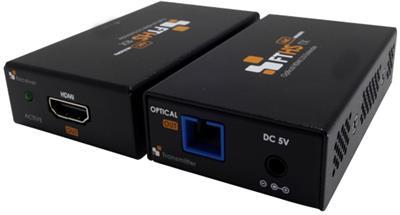
What a fiber optic extender is
A transmitter converts video or USB to light and a receiver converts it back at the display or device. Depending on the model, the pair may also carry USB HID, IR, RS-232, or audio. Fiber avoids electrical interference from dense racks and industrial equipment and reaches paths that HDBaseT cannot. Pair a long fiber run with an HDMI matrix switch when one source must feed several displays, or use a video converter when the source and display interfaces differ.
Fiber optic extender: HDMI vs DVI vs USB
Match the host connector first. HDMI kits cover digital signage and modern AV sources, while DVI kits serve older servers and instruments. DisplayPort and SDI fiber models are available for compatible equipment. USB fiber carries HID or other peripherals, not video by itself. Check each SKU for the supported resolution, refresh rate, and any control signals. Optical HDMI cables in the 66-165 ft range are fixed-length jumpers, not separate TX/RX kits.
| What you need | What to order | Use when |
|---|
| HDMI over fiber, 300 ft-1 km | HDMI fiber TX/RX kit, multimode or singlemode per SKU sheet | Digital signage, control room, rack-to-wall link |
| DVI over fiber | DVI single-link or dual-link fiber kit | Legacy GPU or instrument DVI-D |
| USB HID or peripherals over fiber | USB fiber extender | Keyboard, mouse, or camera beyond copper USB limits |
| Short copper run without EMI concerns | Cat5 HDMI extender | In-room copper is sufficient |
| Short optical HDMI jumper | Fiber optic cable or AOC | Fixed-length cabinet or podium link |
Singlemode vs multimode
Multimode (OM3/OM4) covers many intra-building runs; singlemode (OS2) is used for longer links, including 10 km-class models. Do not mix singlemode optics with a multimode plant. Match connector type, strand count, and distance to the specific kit. Some dual-link DVI units need two fibers. If the source is legacy VGA, confirm a suitable conversion path before specifying digital fiber hardware.
When you do not need a fiber optic extender
Stay with copper when the run fits the product's Cat5/Cat6 rating and electrical noise is not a concern. For many sources and displays in one room, start with an HDMI matrix and use fiber only for the long tails. KVM over IP is a different approach from a point-to-point fiber video kit.